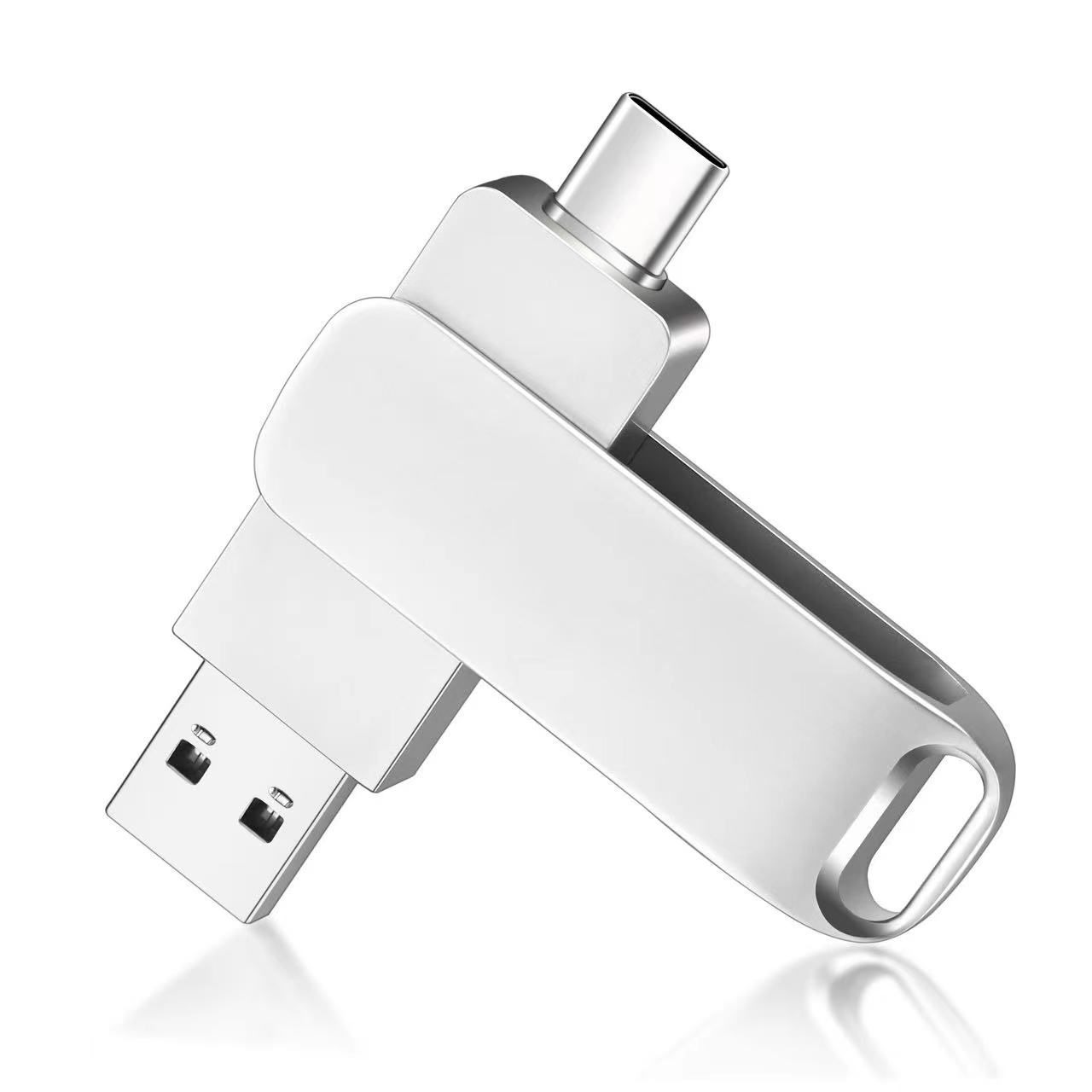
Does the EU Common Charger Rule Cover Promotional USB Drives? A Scope Check
A promotional USB flash drive is not covered by the EU Common Charger rules. Those rules set a common charging port for rechargeable devices such as phones, tablets and headphones; a memory stick has no battery and is never charged, so the regulation never reaches it. The confusion is real, though, because EU procurement officers and corporate buyers increasingly ask for "USB-C only" on promotional items, and the wrong answer on the RFQ can either inflate your tooling cost or trigger a rejection at goods-in. This article sets the legal boundary, then gives you the wording that closes the port question before any mould is cut.
What the EU Common Charger Rules Actually Cover, and What They Leave Out
The EU Common Charger framework (Directive (EU) 2022/2380, amending the Radio Equipment Directive) applies to radio equipment that recharges via wired charging. The named product categories are smartphones, tablets, digital cameras, headphones and earbuds, handheld game consoles, e-readers, portable speakers, keyboards, mice, portable navigation devices, and earphones. For most of these the obligation took effect at the end of 2024: a common USB-C charging port, and a separate sale of the charger from the device where feasible.
Notice what is missing. The list is built around devices that draw power to recharge a battery. A USB flash drive stores data and is powered passively by the host port — it neither charges nor is charged. It is not radio equipment, it carries no battery, and it is not on the enumerated list. The rule therefore neither requires nor prohibits a particular connector on a promotional drive.
Why a USB Flash Drive Sits Outside the Rule but Your Buyer Still Asks
Being outside the rule is not the same as never hearing about it. Two real pressures push the question onto your RFQ:
- Procurement checklists. EU public-sector and corporate buyers run a sustainability or e-waste acceptance checklist that mentions the Common Charger rule. A buyer who copied the clause from a phone tender may tick the same box for a giveaway drive.
- The "everyone is USB-C now" assumption. Recipients increasingly carry USB-C-only laptops and phones. A buyer who plugs their own new laptop in and finds a USB-A stick assumes the stick is "non-compliant" rather than "wrong connector for my device."
The drive is not breaking any law in either case. What it can break is the receiver's expectation, and the cheapest fix is to settle the connector on paper before production, not to argue the regulation at goods-in.
The Port Is Set by the Host Device, Not by the Drive
A USB flash drive is a passive device: it presents a connector and the host supplies power and the data link. The connector you choose only decides which ports it physically plugs into. That single fact dissolves the "is it legal" worry — there is no legal requirement on the drive's connector, only a practical question of which recipient devices it must reach.
So before you quote, the only number that matters is the device mix of the people who will receive the drive. If the audience is a EU university distributing to students on mixed laptops, or a trade show where half the crowd is on USB-C-only phones, the connector decision is a fit decision, not a compliance one. Ask for the device list; do not guess from the regulation.
USB-A, USB-C or Dual-Head: Cost and Fit on the Same Housing
Once you treat the connector as a fit choice, you have three realistic builds on a promotional housing:
- Single USB-C. Cleanest for a USB-C-only audience, but anyone with a legacy USB-A port needs an adapter — and adapters walk off.
- Single USB-A. Still the most universal on existing desktops, TVs and older laptops, but it will not plug into a USB-C-only phone or new laptop without an adapter.
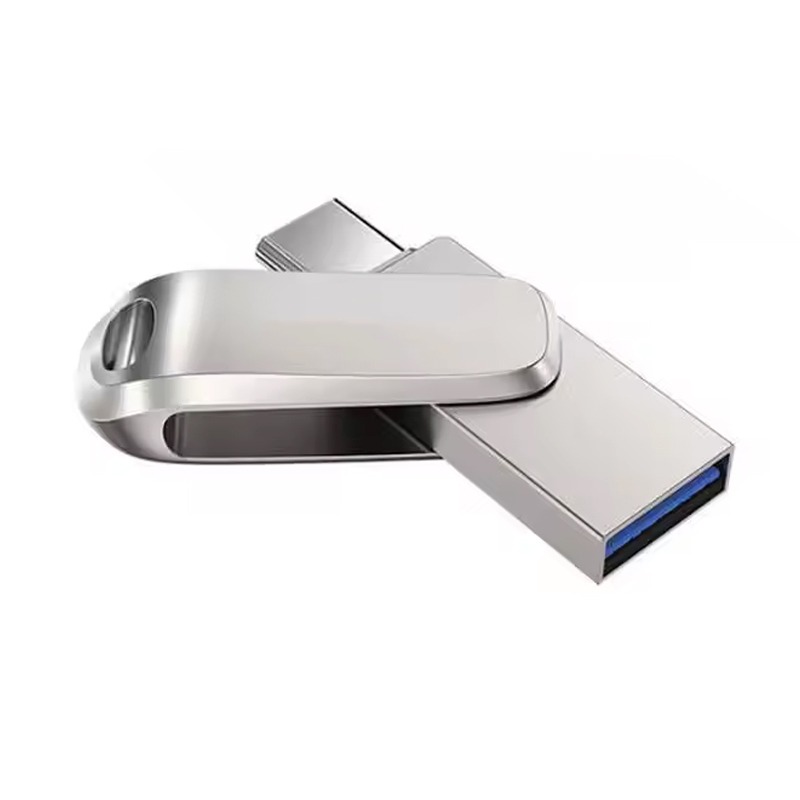
- Dual-head USB-A + USB-C. One body carries both plugs. One SKU covers a mixed-device audience with nothing extra in the box.
The connector choice barely moves the unit price on a standard metal or PVC housing; it does not change tooling unless you are moulding a custom 3D shape around a specific plug. The cost difference that actually matters is the adapter you would otherwise have to pack and the mixed-SKU inventory you avoid by picking the dual-head build.
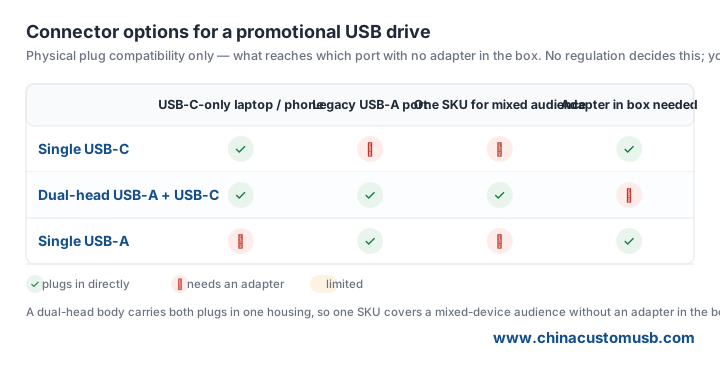
The diagram above is physical compatibility only. It does not reflect any regulation, because no regulation mandates the drive's connector — it reflects which ports each build reaches.
RFQ Wording That Settles the Port Question Before Tooling Starts
Close the question in writing so a downstream buyer cannot reopen it at goods-in. Two lines do most of the work:
"Connector: dual-head USB-A + USB-C on a single housing, unless the recipient device list is confirmed USB-C-only, in which case a single USB-C build will be quoted separately."
And separately, to head off the regulation objection:
"Note: USB flash drives are data-storage devices with no rechargeable battery and are outside the scope of the EU Common Charger rules (Directive (EU) 2022/2380). Connector selection is a device-fit decision, confirmed by the recipient device list above."
With those two lines, the connector is a documented fit choice, not an open legal debate. Send us the destination country and the host devices your recipients actually carry, and we will quote a USB-C-only and a dual-head build on the same housing so you can compare cost before the mould is cut.
Need custom USB drives for your next project?
Factory-direct pricing, free digital proof and a 7-day sample turnaround.
Get a free quote