Custom USB Drives for Musicians: Album Releases Fans Can Keep and Play
A limited album on a USB drive sells for one reason a stream never can: it is an object the fan can keep. Streaming pays fractions of a cent and leaves nothing on the shelf. A USB edition, priced as merchandise, keeps most of the sale and gives the buyer something to hold. If you are an independent artist planning a run of a few hundred, the decisions that decide whether the drive delights or disappoints are made before the factory starts: what goes on it, which file system, body and connector, and how many units to order. This guide walks them in the order a first-time buyer hits them.
Why Artists Are Putting Albums on a USB Again
The appeal is not nostalgia for plastic. A drive solves three problems at once. First, it is a physical souvenir in a market where almost nothing is physical, so it justifies a merch price that a download never would. Second, it can carry more than the audio: a digital booklet, unreleased demos, a video, lyrics, or a thank-you note that turns a purchase into a relationship. Third, it works offline, which matters for fans on long drives, in the studio, or in places with poor data connections. A well-made edition is a small box of value rather than a single file.
That only works if the drive is treated as a product, not an afterthought: an unlabeled drive that mounts to an empty folder feels cheaper than a stream. The unboxing is part of what the fan paid for, so the body, print, and first screen all deserve the attention the music got.
What to Preload Besides the Tracks
The tracks are the minimum. A collectible edition earns its price with the extras, and the good ones cost nothing to add at preload time. Put the master audio in a straightforward folder structure: one folder for the album, a separate one for bonus material, and a plain-text readme at the root explaining what is where. Add the liner notes as a PDF and the artwork as image files. If you have a music video or a short behind-the-scenes clip, include it at a resolution that plays on a laptop without stuttering. A signed-than-you-think touch is a short text file addressed to the buyer; it costs you an afternoon and reads as personal.
Two rules prevent most complaints. Keep filenames simple and avoid special characters, because some car stereos and older players choke on them. And decide whether folders should be read-only: locking stops accidental deletion of the booklet, but annoys anyone copying the audio to a phone. For a collector item, unlocked is usually friendlier.
Pick a File System Your Fans Can Actually Play
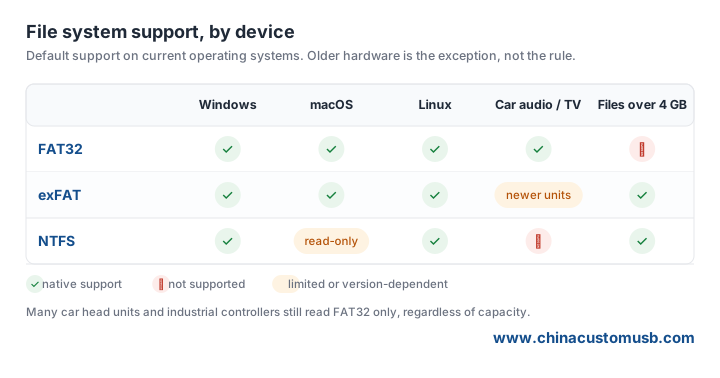
Format is the quiet deal-breaker. The drive you format on a modern laptop may not read in the device a fan plugs it into. FAT32 is the safest default for a music giveaway: it is understood by Windows, macOS, Linux, most car head units, and most TVs, but it will not accept any single file larger than 4 GB. For a folder of audio tracks and a PDF booklet, that ceiling is rarely a problem. exFAT lifts the 4 GB limit and is native on current Windows and macOS, but some older car stereos and TVs will not mount it. NTFS is a poor choice for a drive meant to roam: macOS generally reads it but will not write to it by default, and many non-PC players ignore it entirely.
The practical answer for a small music run is FAT32 unless you know you are shipping a single large video file, in which case exFAT plus a note in the readme is the better trade. Whatever you choose, test the formatted drive in one car stereo and one non-owner laptop before you preload the whole batch. A ten-minute check catches the failure that would otherwise generate a hundred support emails.
Capacity, Connector and Body Choices for a Small Run
Capacity is easy to overspec. A lossless album with a booklet and one video fits comfortably in 8 GB, and most small runs do not need more than 16 GB. The temptation to order 32 GB or 64 GB is understandable, but a bigger drive only helps if the buyer has a use for the space after the music; otherwise it is cost with no perceived value. If the pitch is "the whole discography plus videos," size up and say so on the sleeve so the capacity feels justified.
The connector is a genuine decision now. USB-A still matches the majority of laptops, car ports, and desktop docks, which is why it remains the safe default for a broad fan base. USB-C suits a younger, laptop-first audience, but a C-only drive will frustrate anyone with an older A-only port; if you go C, consider including a small adapter in the pack. The body is where a collectible earns its keep. A wooden shell, a metal card, or a molded shape reads as an object worth keeping, while a plain plastic stick reads as a throwaway.

That combination of a natural material and a laser-etched logo is a good match for a small music edition: the etching is permanent, it needs no color registration, and the key loop keeps the drive attached to a bag or keys long after the album has been played.
Pricing a Limited USB Edition Without Overordering
Start from the price the fan will pay, then work backward to a quantity you can afford to hold. A limited run only stays limited if you are honest about how many will sell: 200 numbered copies that sell out beat 1,000 that sit in a drawer. Order a sample first to confirm print and preload, then place the smallest run the supplier accepts and price it as a collectible, not a discounted CD.
Build a per-unit picture before you commit: drive and body, logo process, packaging, preload labor, freight. Get these as separate line items in one quote so you can see which choice moves cost. Packaging is the easiest place to protect margin without touching the electronics: a printed sleeve lifts perceived value more than a capacity bump. Plan the unsold units into the price; if holding half the run would upset you, the run is too big. Numbering each copy and printing the edition size makes the scarcity real and gives buyers a reason to order before it is gone.
Done well, a USB album is not a gimmick. It is a small, durable piece of the relationship between an artist and a listener, and the choices above are what make it feel deliberate instead of cheap. If you are planning a limited run and want help matching the body, capacity and packaging to your budget, request a free sample and quote and we will walk the options with you.
Need custom USB drives for your next project?
Factory-direct pricing, free digital proof and a 7-day sample turnaround.
Get a free quote

