Factory or Trading Company? 6 Checks That Show Who Actually Makes Your USB Drives
A USB drive quote is rarely just one company's number. In the promotional USB market, the party that replies to your RFQ may run its own injection, SMT and assembly lines, or it may be a trading company that collects your requirements and places the order with one or more third-party workshops. Both can return a finished drive that looks correct. The difference shows up later: when a batch fails a capacity test, when you want to change the shell colour after tooling, or when you ask who signed the QC report.
What Sits Behind a USB Drive Quotation
The trading layer is not dishonest by default. Many buyers work with trading companies because they consolidate small orders, handle export paperwork and smooth out language gaps. The risk appears only when you assume you are talking to the maker and plan your verification around that assumption. A factory quotes what its own line can build; a trader quotes what a partner has room for this week. Same keyword, two different supply bases.
Before you commit volume, separate the two. The six questions below do that with answers you can check, not promises you have to trust.
Six Questions That Reveal Whether the Supplier Owns a Line
Send these six questions with your RFQ. How the answers arrive tells you more than a company brochure.
- Where is the sample made? Ask whether the sample comes from the same line that will run your mass production. An own-line supplier names the workshop and shift; a trader answers "we will arrange it."
- Who holds the steel mold? For a custom shell, the injection mold locks your shape. A factory stores it on-site and shows the mold number; a trader keeps it at a partner and may not control re-opening it.
- Who signs the QC report? Capacity, write-speed and appearance checks should be signed by the maker's QC, not forwarded from an unknown workshop.
- Can I audit the assembly floor? A factory offers a video call from the line; a trader offers a showroom or a partner introduction.
- Can the BOM change directly? Switch a controller chip or connector grade and the quote should move in hours from the engineer, not days through a relay.
- What happens after a mold swap? If a shell mold breaks mid-campaign, the party that owns tooling re-runs it; the party that rents it waits on a supplier's schedule.
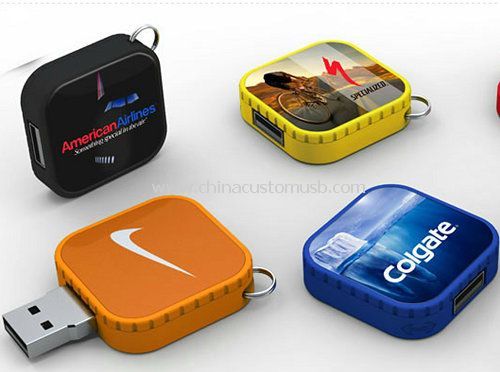
Below is one unit we mold and assemble on our own line - the kind of product these six questions qualify. When you can see the actual shell being produced, questions 2 and 5 stop being theoretical.
Where the Two Quotes Diverge: Sample Source, Tooling and QC Sign-Off
The same phrase "USB flash drive 8GB" can return two quotes that differ by more than price. Map each control point to who can actually act on it.
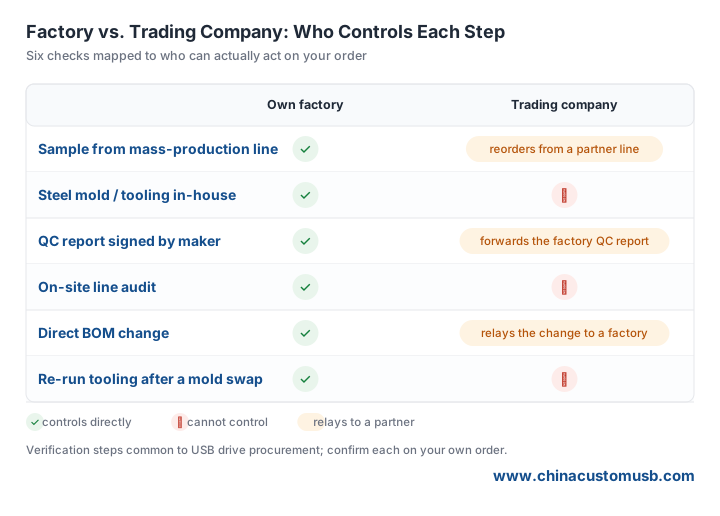
Read the table left to right. If a supplier answers "yes" to tooling and floor audit but "partial" to a direct BOM change, you are likely talking to a trader with one strong partner. That works for a stable reorder; it is risky for a first campaign where you will still iterate the design.
Red Flags in an RFQ Reply That Point to a Middleman
None of these alone proves a trader, but together they shift the odds. Watch for a quote with no mold number, a sample photo that does not match the mass-run shell, or a QC report with no maker's stamp. A reply that deflects "who assembles this" with "our partner factory" three times is telling. So is a lead time quoted as a wide range with no explanation of which step drives it.
Another signal: the supplier cannot name the controller family or NAND grade on the spot, because that decision sits one conversation away. You do not need a specific brand in the answer - you need it to come from the same desk that quoted you.
What to Put in the PO Whichever One You Pick
Once you know who you are dealing with, write the PO to match. For an own factory, name the mold number, the QC checkpoint list and the preload file hash so a rerun is identical. For a trading company, state in writing that samples must come from the mass-production line and that the factory QC report must carry the maker's sign-off - then verify one batch yourself before the full run.
Both routes can deliver good drives. The mistake is buying a factory relationship and getting a trading one, or paying trader prices while assuming factory control. Send your target capacity, order quantity and artwork status, and we will quote from our own production line with the QC checkpoint list attached.
Need custom USB drives for your next project?
Factory-direct pricing, free digital proof and a 7-day sample turnaround.
Get a free quote