USB Lanyard or Keyring Loop? 5 Attachment Checks Before an Event Giveaway Order
The attachment is what breaks first at a giveaway, not the flash chip. For an event order the decision comes down to one question: will the recipient carry this on a neck cord at a conference, or on a keyring for the next two years? Neck carry suits a multi-day event where people need both hands free. A split ring suits a one-day handout that goes onto a keyring and gets re-seated for years. Pick from that scenario, then size the hole in the shell to match, because the same body cannot serve both without a shell change.
Two Attachments, Two Load Paths: Neck Carry Against Pocket Carry
A lanyard hangs from a cord threaded through a grommet eyelet on the shell. The shell hangs nose-down, so the entire weight of the body plus the connector sits on a narrow cord loop, and every step the wearer takes adds a small dynamic push on that loop. The load is not the drive weight alone; a 15 g body swinging against a chest at walking pace puts several times its static weight on the grommet edge for a fraction of a second, thousands of times a day.
A split ring does the opposite. The ring passes through a boss hole moulded into the end of the shell, and the drive hangs at an angle rather than straight down. There is no swinging cord, but the ring rotates freely, so it abrades the inside of the hole, and the load lands on the wall of the boss rather than on the edge of a metal eyelet. That difference sets both the failure point and the tooling cost.
Where Each One Fails First: Cord Grommet, Split Ring and the Boss in the Shell
On neck carry the failure order is predictable. The cord frays where it rubs the eyelet edge, usually within the first weeks of daily use on a woven polyester cord. The eyelet itself then pulls out of the shell wall if the wall is thin. On keyring carry the order changes: the split ring opens at the gap and lets the drive walk off, or the boss wall cracks from the hole outward.
Three dimensions decide which of those you get, and all three are cheap to specify on a drawing:
- Hole diameter against cord or ring size. A 2.0 mm cord needs a 2.5 to 3.0 mm hole; tighter than that and the cord binds and frays against the rim, looser and the shell tilts and rubs. For a split ring, the hole has to clear the ring wire with a little play: 0.8 mm wire in a 2.2 mm hole is a workable pair, 1.2 mm wire needs a wider boss.
- Edge distance from hole to the outside wall. Keep at least 1.5 times the wall thickness between the hole and the outer surface. A 1.2 mm ABS wall with a hole drilled 1 mm from the edge is a crack waiting for the first drop.
- Boss thickness around the hole. The material around the hole should be thicker than the general wall, not the same. A local boss of 2.0 mm around a 2.5 mm hole survives a pull test that splits a 1.2 mm wall.
Geometry matters more than material: ABS holds a light shell with a grommet, while polycarbonate or a metal insert earns its cost when the shell is heavy or the drive shares a keyring with metal that grinds.
Matching the Attachment to the Handout: Conference Bag, Counter Giveaway, Daily Keyring
The matrix below is the version we work through with buyers before quoting, because it turns a vague preference into a load case. Read across the row for the handout you are planning and only the column that fits survives.
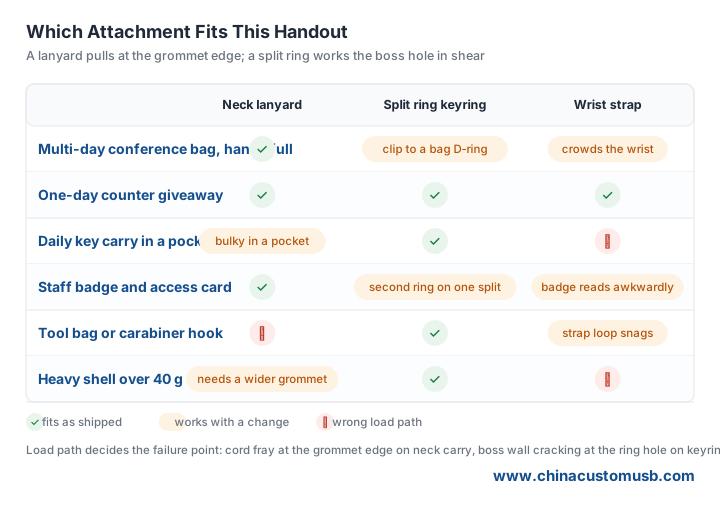
Two rows are worth calling out. Staff badge and access card is the case where people want a lanyard but the drive is an afterthought: a second ring on one split tangles with the badge clip. Tool bag or carabiner is where a cord is simply wrong, since the loop snags on hooks. Heavy shells above roughly 40 g need a wider grommet or they chew the cord at the rim, the most common complaint we get on event returns.
What the Attachment Changes in Tooling, Assembly and the Unit Price
The attachment is not a free option bolted onto the same body. Adding a grommet eyelet or a boss hole after the shell tool is cut means either a slide change in the mould or a secondary drilling operation, and both carry a one-off cost that does not shrink with the order quantity. Decided before the tool is cut, the hole is moulded in and the cost is close to zero.
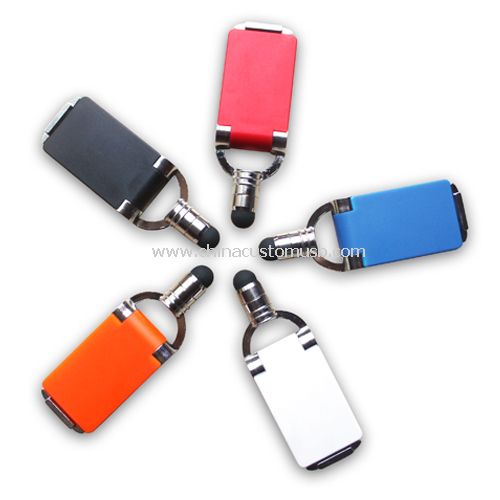
Assembly changes too. A lanyard adds a threading and knotting step, and the knot has to sit inside a recess or it shows through the print area. A split ring is a one-second fit, but the ring has to be the right gauge for the hole or the drive hangs crooked. Packing is the step buyers forget: cords tangle in a bulk carton, so lanyard orders usually ship cord-detached and bagged, which adds handling cost per unit.
Sample Check: Pull, Swing, Re-Seat and Drop Before the Bulk Run
Four checks on two or three samples will tell you more than any spec sheet, and none of them need a lab:
- Pull. Hang five times the drive weight from the attachment for one minute, or use a luggage scale to a steady 5 kgf. The grommet should not lift out of the shell and the boss should not whiten at the hole.
- Swing. Hold the cord at the top and let the drive swing fifty times at walking amplitude. Then look at the cord where it crosses the eyelet edge. Fuzzing there means the hole is too tight or the rim is sharp.
- Re-seat. Open and close the split ring two hundred times on a keyring. A ring that has lost its spring or shows a widened gap will drop the drive in a pocket within months.
- Drop. Drop the assembled unit from 1.2 m onto a hard floor, five times, on the attachment end. Cracks start at the hole, not at the connector, so check the boss under a light.
Run the four checks on both options on the same body if you are undecided. It costs one extra sample and settles the question with evidence.
Send the handout scenario and the quantity you are planning, and we will quote both attachment options on the same body with a sample of each so you can pull-test before the order. Tell us whether the drive hangs on a neck cord or a keyring, and whether the shell is already tooled, so the quote separates the one-off hole cost from the unit price.
Need custom USB drives for your next project?
Factory-direct pricing, free digital proof and a 7-day sample turnaround.
Get a free quote