Cheap vs Quality USB Flash Drives: 4 Things the Chip Grade Changes in a Bulk Order
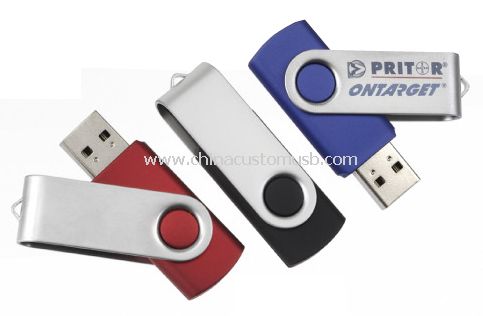
Two USB flash drives, both labelled 16GB, both in a plastic swivel body, can land on your desk with a 30 to 50 percent gap in unit price. The capacity is identical and the logo looks the same. What the cheaper quote quietly drops is inside the case - the grade of the NAND memory and the controller that manages it. This guide explains what that grade actually changes for a bulk order, and which parts of a quote or spec sheet already tell you which tier you are buying.
Why Two Drives at the Same Capacity Quote at Different Prices
Memory is a commodity sold in tiers. A fab produces NAND wafers, bins them by how many cells passed testing, and sells the cleanest bins at a premium while the marginal bins move at a discount. A drive maker assembling a bulk promo order can build the same 16GB body around any of those bins. The printed capacity never changes, so the difference never shows up on the product page - it shows up as a lower price and, later, as different behaviour when the drive is actually written to.
For a one-time giveaway that gets formatted once and read a handful of times, the cheapest bin is often fine. For a drive that ships with your software, gets re-written at trade shows, or is meant to last on a keychain for years, the bin grade is the difference between a drive that still mounts in month eighteen and one that starts returning write errors after a few cycles.
NAND Grade: New Cells, Downgraded Cells and Recycled Cells
Three sourcing tiers show up in promo USB pricing, and they are not the same product wearing a different label. New prime NAND comes from the top bins of a current production run. Downgraded, or secondary, NAND passed testing but at a lower margin - slightly more bad blocks and a smaller usable window before speed falls. Recycled or refurbished NAND is pulled from earlier devices or failed batches, re-tested, and re-packaged; it works, but its remaining write life is the shortest of the three.
The table below maps what each tier actually delivers on the things a bulk buyer cares about. None of it is a brand claim - it is how the memory was sourced and binned before it reached the assembly line.
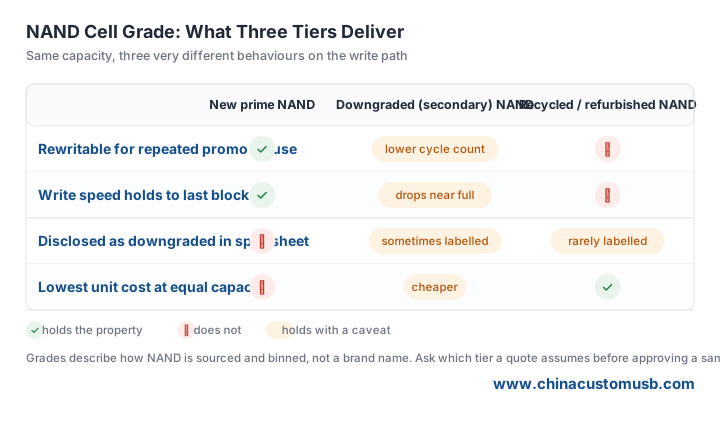
The practical takeaway: the cheapest quote at equal capacity is usually assuming the recycled or downgraded tier unless the spec sheet says otherwise. That is a reasonable choice for a throwaway giveaway and a risky one for anything that carries data you cannot lose.
Controller and Speed Class: What a Write Test Actually Reveals
The controller is the small chip that decides where each block of data goes. A competent controller spreads writes evenly and quietly remaps bad blocks; a stripped-down controller does the minimum and lets weak areas surface as slowdowns or failed writes. You rarely see the controller named on a promo quote, but you can feel it in a write test.
Copy a large folder - several gigabytes, not a few small files - to the sample and time the second and third passes, not the first. A drive built on prime NAND with a capable controller holds its speed across passes. A downgraded build often starts fast, then drops sharply once the faster cache fills and the weaker cells take over. A recycled build may vary pass to pass because its bad-block map is already partly used. The number that matters is not the peak MB/s on the box; it is whether the speed stays put when the drive is nearly full.
What a Buyer Can Check Without Opening the Case
You do not need to desolder a chip to read the tier. Three checks work before a single unit ships:
Ask for the grade in writing. A supplier who sources prime NAND will state it. Silence, or a spec that only lists capacity and interface, usually means the tier floats with whatever was cheapest that week.
Run a write-and-verify loop on the sample. Fill the drive, read every byte back, repeat three times. Count mismatches. Prime NAND returns zero; downgraded tiers occasionally trip on the later passes; recycled tiers trip more often and earlier.
Check the body the grade is paired with. A metal or aluminium shell dissipates heat better during sustained writes than a thin plastic shell, which slightly extends comfortable write windows regardless of tier. That is a reason to pair a downgraded build with a better casing, not a reason to assume the memory is better than it is.
Spec Wording That Locks the Grade for the Next Batch
The way to stop the tier from drifting between orders is to name it in the purchase spec. Three phrases do the work:
"New prime NAND, not refurbished or recycled." This single line removes the two cheapest tiers from the quote by definition.
"Grade A cells, bad-block remapping by controller." It forces the assembler to use a controller that actually manages weak cells instead of ignoring them.
"Write-verify three cycles, zero mismatch, sample retained." It turns the test from the previous section into a contractual acceptance step, with a kept sample so the next batch can be compared against the approved one.
None of these raise the price sharply for a genuine promo build, and they remove the ambiguity that lets a "cheaper" quote mean "different product."
Putting the Grade Into Your Bulk Order
The grade only matters once it sits inside a body your recipients will actually keep. For high-volume giveaways a compact keychain drive is the workhorse: it survives the pocket, takes a clean laser or print logo, and pairs with any of the three tiers depending on how the drive will be used. Match the tier to the job - prime for anything data-critical, downgraded for the one-time handout - and the same body quotes two ways on purpose.

If you are deciding between a cheaper and a pricier quote on the same capacity, the question is not "which is the scam." It is "which tier does each assume, and is that tier right for how this drive will be used." Answer that, and the price gap stops being mysterious.
Send us your capacity, quantity and target unit price, and we will quote two build grades on the same body so you can see exactly what the cheaper quote drops before you approve a sample.
Need custom USB drives for your next project?
Factory-direct pricing, free digital proof and a 7-day sample turnaround.
Get a free quote