Fake Capacity USB Drives: 5 Checks Before You Pay for a Bulk Order
A quote that lands well under the field on the same capacity is the moment to slow down. Fake capacity is not cosmetic: the drive reports 64 GB, the buyer fills it with 64 GB of files, and the last 20 GB quietly overwrite the first 20 GB or vanish on the next re-plug. The person who finds out is your customer, months later, holding a branded object that ate their photos. Five checks, run in order, cost a few hours and prevent that.
How Fake Capacity Works and Why It Destroys a Campaign
Capacity is a number written into the controller firmware, not something the NAND announces by itself. A 16 GB chip paired with firmware that reports 64 GB will accept a 64 GB write. Once the real cells are full, the controller wraps around and overwrites earlier data, or drops the sectors and reports success. Nothing warns the user during the copy. The failure surfaces later, when a file will not open or a folder that was there yesterday is empty.
Three supply patterns produce this. Recycled NAND is pulled from retired devices and re-marked; downgrade chips are parts that failed full-capacity testing at wafer level and are sold at the smaller capacity they still pass; firmware-modified drives are ordinary low-capacity units with the reported size edited upward. All three cost less per unit than first-run NAND, which is why they show up in quotes for large promotional orders nobody checks.
The damage is the sequence: the recipient assumes the file is corrupt, then blames the brand that handed out the drive. A 2,000-piece order with a 15% fake rate means roughly 300 people holding a broken deliverable.
A Full-Capacity Write Test on the Sample, Not a Speed Benchmark
Order two or three units at the quoted price and pay for them. Free samples often come from a different bin than the production run, so a free sample that passes proves less than a paid one. Run a full-capacity test with h2testw on Windows or f3 on macOS and Linux; both write test files until the drive is full, then read every file back and compare.

Budget the time honestly. A 64 GB drive writing at 8 MB/s needs about two hours to fill and another 30 to 40 minutes to verify, so run several drives in parallel on a powered hub overnight. A genuine unit ends with a line reporting the full capacity verified and zero corrupted sectors. A fake one ends with a split result such as 47 GB written without error plus 16 GB lost or corrupted, which is the physical capacity showing through the firmware claim.
CrystalDiskMark is not a substitute: it tests only the start of the drive, the part a wrapped controller handles correctly, so a fake passes. Format as exFAT first, since FAT32 cannot hold a file above 4 GB.
Reading the Controller and NAND on Arrival Units
Once the goods land, the sample that passed is no longer the question. Pull one unit from every tenth carton and read what is inside with a tool such as ChipGenius or Flash Drive Information Extractor, which reports controller model, NAND vendor and firmware capacity. A unit that claims original chips from a major vendor but reports an unknown NAND vendor is a mismatch worth a written question before the balance is released.
The controller family also sets the speed ceiling. A USB 2.0 controller reads at roughly 15 to 20 MB/s whatever the label says; a USB 3.0 controller should hold 60 MB/s or more on a large sequential read. If the quote promised USB 3.0 and the units read at USB 2.0 speeds, one file copy proves it without a lab.
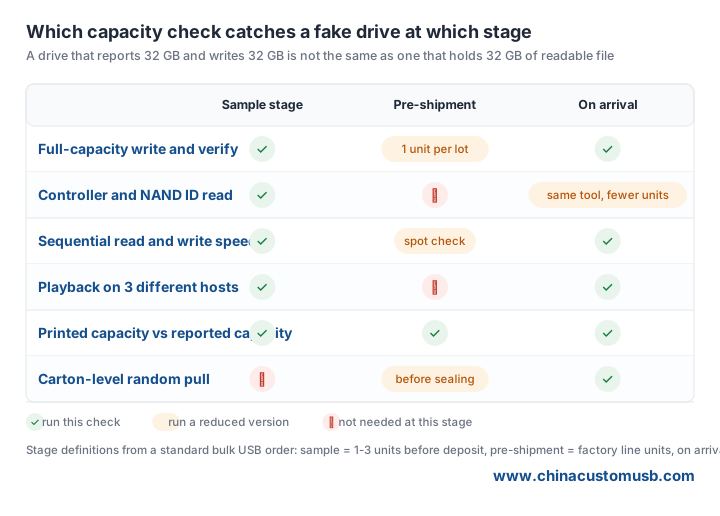
Sequential read speed across the whole volume is the second signal. Copy one large file and watch the graph: a genuine drive holds a fairly flat line, while a wrapped controller or a small fast cache followed by slow memory drops sharply in the final stretch. A fall from 80 MB/s to under 10 MB/s over the last fifth means the headline capacity is being served by much slower memory than the number implies.
File Integrity Across Hosts and After a Week
Capacity passing does not mean the data survives. Load a real payload on each pulled unit, the kind of content the campaign will carry: a folder of PDFs, a few video files, an HTML index. Generate checksums with certutil on Windows or shasum on macOS, copy, eject, re-plug and compare. Repeat on a machine running a different operating system, and through an OTG adapter if mobile users are the target.
Leave one loaded unit on a shelf for a week and test it again. Weak or recycled memory loses charge over time, so files that read correctly on day one can fail on day eight. A same-day test cannot see this.
Record every lot in one table: carton number, tool, reported capacity, verified capacity, read speed, checksum result. Suppliers answer a lot number faster than a general complaint.
Capacity Guarantees and Refund Terms That Belong in the PO
Checks protect one order; contract language protects every order after it. Four clauses do most of the work: a capacity statement (each unit must hold the ordered capacity, verified by a named full-capacity test), a failure threshold with replacement at supplier cost including freight, a batch test report with the tested serial range and the tool used, and a payment hold that releases the balance after the arrival test passes.
Ask what the supplier guarantees when a drive turns out short on capacity. The answer should be a number and a process, not a reassurance. Our published terms are genuine capacity, original chips, a five-times refund if a drive is proven fake, and a three-year warranty; use that as the benchmark, because a supplier who will not put a multiplier in writing is pricing that risk into your campaign rather than their margin.
Add a print clause: if the housing carries a printed capacity, print and firmware must match, and a mismatch is a defect whatever the drive holds. A 32 GB drive printed as 64 GB causes the same complaint, and it is cheaper to fix at artwork approval than at the trade show.
Two paid samples, one overnight run, one chip read and one checksum pass take a single working day and cost less than a hundred drives. In exchange you know the capacity is real before tooling, print and freight are committed. Send the capacity, housing style and deadline, and we will quote with the capacity guarantee and test report terms already written in. Request a free sample and quote, then run the write test yourself before the bulk order.
Need custom USB drives for your next project?
Factory-direct pricing, free digital proof and a 7-day sample turnaround.
Get a free quote