Wooden USB Drives for Eco Branding: Wood, Cork and Finish Checks Before a Bulk Order
If your campaign brief says "less plastic" and your European buyers keep asking what the handout is actually made of, a wooden USB drive is the easy win — but only if you choose the body material and the finish before the quote, not after. The wood shell changes three things on every order: how the logo stays on, how the unit behaves in humidity and heat, and what you are allowed to print on the box. This guide covers the three wood bodies we actually produce — natural wood, two-tone, and cork stopper — and the sample checks that keep a bulk run from shipping with a claim you cannot keep.
Why Wood Instead of Plastic for a Sustainability-Led Giveaway
Plastic shells are cheap and uniform, but they are also the first thing a procurement manager flags when the brief says "eco". A wood body reads as a different material the moment it is in hand: it has grain, it has weight variation, and it does not look like the hundred other polystyrene giveaways in the tote bag. That signal is the whole point of a sustainability-led campaign.
The catch is that wood is not a single material. "Wooden USB" can mean a solid natural-wood cap, a two-tone body glued from two wood shades, or a cork stopper set into a shell. Each one quotes differently and each one fails differently, so the first question on the brief should be which of the three you want — not just "wood".
Natural Wood, Two-Tone and Cork Stopper: What Each Body Changes in the Quote
The body material drives the unit price through three inputs: the blank cost, the engraving or print setup, and the sealing step. Natural wood is usually the baseline. Two-tone adds a lamination and alignment step because two wood shades have to meet on a clean line. Cork stopper adds a fitting step and is the most sensitive to moisture, so it also needs the most sealing.
None of the three is "the eco one" by default. A two-tone body is still wood, but the adhesive that holds the two shades and the sealant that keeps it from splitting are not something you can separate at a recycling centre. If the buyer's brief says "recyclable as one piece", natural wood is the only one of the three that ships without glued layers.
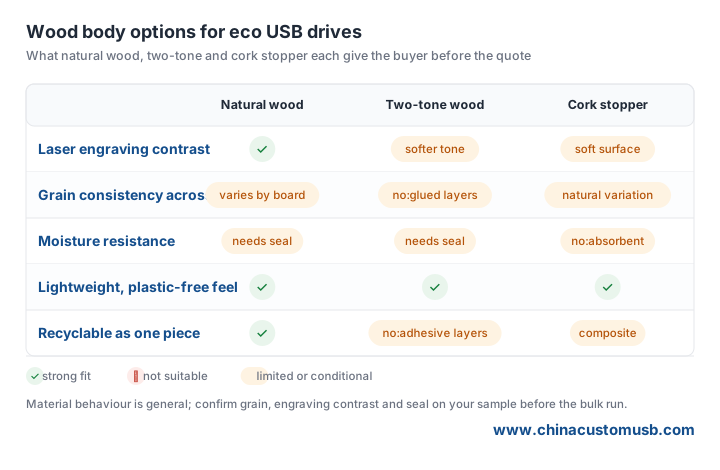
The matrix above is a starting point, not a spec sheet. Grain variation, engraving contrast and moisture behaviour all move with the specific wood grade and sealant we use, so the real numbers come from the sample, not from this table.
Finish and Edge Wear: What a Wood Body Looks Like After a Year of Handling
The logo question is where wood and plastic diverge hardest. On plastic you print or pad-print a colour mark that can rub off at the edge of a keyring. On wood you laser-engrave: the laser burns the surface, so the mark is the wood itself, not a coating on top of it.

That matters for edge wear. A printed logo on a drive that lives on a keyring loses legibility in months; an engraved mark on a wooden body stays readable because there is no layer to flake. The trade-off is colour — engraving is monochrome by nature, so if the brand needs a full-colour mark, wood moves you to a printed or UV option and you give up the "it will not wear off" property.
Edge wear also shows up at the seam. On a two-tone body the glued line is the weakest point: if the seal is thin, you will see a hairline gap after a few months in a warm pocket. That is a sample check, not a catalogue claim.
Humidity, Heat and Cracking: Three Checks to Run on the Sample
Wood moves. Three checks catch the failures before they reach the bulk run.
1. Humidity soak. Leave the sample in a sealed box with a damp cloth for 48 hours, then check for warp or a lifted seam. Cork is the one to watch here — it is the most absorbent of the three and the most likely to swell.
2. Heat. Sit the sample on a dashboard or near a radiator for a day. Heat dries the sealant and can open the two-tone glue line or crack a thin natural-wood cap. If the body feels dry or the seam shows, the sealant grade is wrong for the market.
3. Cracking at the edge. Gently twist the cap and run a fingernail along every glued edge. A natural-wood cap should not crack; a two-tone body should not open; a cork set should not separate from the shell. Any of the three failing this on the sample means the bulk run will fail it in the field.
Claims You Can Print and Claims You Cannot
This is the part that gets buyers into trouble, because the wrong phrase on the box is the one thing you cannot take back after printing. You can print that the body is wood, that the logo is laser-engraved, and that the unit is plastic-free in the shell. You cannot print "biodegradable" unless the whole unit — including the PCB, the connector and the sealant — is certified, and a wood cap alone is not.
You also cannot print a specific recycling claim like "recyclable in standard municipal streams" without a test report for that exact build, and you should not put "FSC" or any forestry mark on the box without the licence number in hand. Those marks carry a certifier's logo and a number; printing them without the licence is a compliance problem in the EU, not a marketing one. Keep the box copy to what the sample proves, and the bulk order stays clean.
Send your campaign brief and handout date and we will mail a natural wood, two-tone and cork sample set so you can check the finish and the engraving on the real body before the bulk run.
Need custom USB drives for your next project?
Factory-direct pricing, free digital proof and a 7-day sample turnaround.
Get a free quote

