Pantone Matching on Custom USB Drives: How ABS, PVC and Aluminium Read the Same Colour Code
Two bulk runs of the same drive, same Pantone number, a few months apart: put the second batch next to the first on a desk and one of them looks a shade warmer. Nobody can prove which one is wrong, because the one thing everyone agreed on was a number printed on paper. On a custom USB drive a Pantone code is a reference, not a finish, and it has to be re-established on the actual body material before the mould runs.
The chip is paper, the body is not
A Pantone Solid Coated chip is ink laid on smooth, sealed, bright white coated stock. Three properties come free with that paper: an opaque white base, a glossy surface, and a very thin ink film. A USB body has none of the three.

Three things decide the reading on a moulded body: pigment load in the compound, the texture of the tool, and the base material underneath. Change one and the same code lands somewhere else. A polished tool face reflects more light back and reads darker and more saturated; a matte or textured face scatters light and reads lighter and flatter. Two factories quoting the same number can both be honest and still ship two different colours.
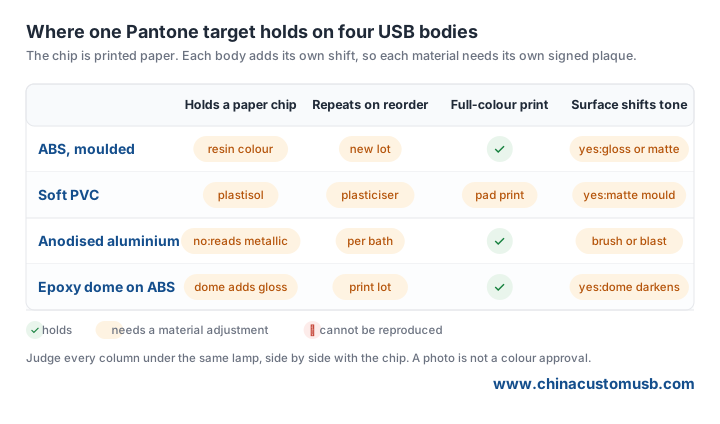
ABS, PVC and aluminium read the same code differently
Moulded ABS. Colour is mixed into the pellets as masterbatch before the part exists, so there is no ink film at all. The result usually reads deeper than the printed chip at the same nominal code, and the mix has to be built for the material rather than copied from a print recipe. Base resin grade matters, and so does regrind: a run using a high proportion of reground sprues drifts warmer and duller. If colour is a brand issue, agree a regrind cap in writing.
Soft PVC. Treat it as a moulded rubber part rather than a plastic shell. Pigment is dispersed through the compound with plasticiser, and the mould face is almost always matte, so the surface scatters light and the colour reads soft. Dark saturated shades are easiest to hold; light neutrals, pastels and bright oranges are hardest, because the matte face and the translucent edges of a soft part both pull the reading. Plasticiser can also migrate, which is why a pale PVC body may look slightly warmer after a year in a warehouse.
Anodised aluminium. Dye is absorbed into the porous oxide layer and then sealed. Because the metal underneath reflects light, any chip you send comes back with a metallic shift; anodised aluminium never looks like flat ink. Mid and dark blues, greys and blacks are the predictable end of the range, while bright reds, yellows and pale tints are the difficult end, and a tint that looks close on a flat plaque can look plainly different once the part is curved. Laser engraving removes the dye and reveals raw metal, so an engraved logo is a light metallic mark, not a white print.
ABS under an epoxy dome. A common construction for promotional drives: a printed insert covered by clear resin. The dome adds gloss and slightly deepens the tone, so a colour approved on the flat insert will not match the finished part. Approve the domed sample.
Reading a target: Solid Coated, Bridge, and plastic plaques
Most brand guides quote Solid Coated, so that is the number buyers send. Two traps follow. Solid Uncoated chips are visibly lighter and duller than their coated siblings, so a discussion where one side holds a C chip and the other a U chip produces disagreement that has nothing to do with the factory. The Bridge guide, in turn, gives CMYK, RGB and hex equivalents: useful for print artwork and screen mockups, but not a recipe for resin, since you cannot mix process inks into ABS pellets and get the printed result. Treat Bridge values as a communication aid, not a specification.
Pantone also publishes plastics chips for a range of polymers: the closest thing to a plastic reference, but still not your resin, your pigment supplier and your tool finish. The practical answer is a physical plaque: a small plate moulded in the same material with the same tool texture, or anodised by the same process, before the production run. That plaque is the document; everything else describes it.
Judging the plaque: light, angle, and a number
Colour approval fails more often on viewing conditions than on pigment. Judge under a daylight-balanced source in the 5000 to 6500 K range, with chip and part on the same surface at the same angle. Warm showroom bulbs, warehouse lighting and phone flash all push the reading.
Rotate the part. Metallic finishes change with angle, and a curved body shows a highlight band that a flat chip never has. Then put a number on the tolerance instead of arguing about words. Delta E is the standard measure of colour difference, and the CIE2000 form is what most plastic suppliers now quote. An acceptance band around Delta E 2 is common for moulded parts, and differences above roughly 3 become visible when two parts sit side by side. Write the band into the purchase order together with the illuminant used and who measures, and do not approve from a photograph, because camera white balance and an uncalibrated screen will mislead both sides.
What to send with the artwork
A brief that produces a usable match usually contains seven items: the Pantone number and which guide it came from; the body material and surface finish; where the colour sits, meaning moulded body colour, a printed panel or an insert under a dome; a physical chip or brand guide page; vector artwork with fonts outlined and the smallest line width stated, since small type on a curved body is a separate decision from colour; the number of colours if the logo is pad or UV printed; and for a repeat order, the master chip, the earlier lot number and the Delta E accepted last time.
Repeat orders and mixed batches
Colour drifts on reorders for boring reasons. Masterbatch lots change, a resin supplier substitutes a grade, a tool is re-polished and comes back glossier, an anodising bath is refreshed. None of that is negligence, and all of it is invisible unless somebody checks. Ask for masterbatch lot confirmation with every repeat order, and a new plaque whenever the lot changes. Keep two master chips, sign and date both, and store them dark and dry rather than on a windowsill, since daylight fades a physical reference as surely as it fades the product.
For mixed-material orders, approve one plaque per material and keep the plaques with the shipment paperwork. A single chip covering an ABS body, a soft PVC accessory and an anodised plate is not a standard, it is a guess. If colour is critical, pack by production lot and label the cartons.
Send the Pantone number plus the body material you plan to use, and we will produce a colour plaque on that exact material and finish, so you can hold it against your brand guide under your own light before the run is committed.
Need custom USB drives for your next project?
Factory-direct pricing, free digital proof and a 7-day sample turnaround.
Get a free quote

